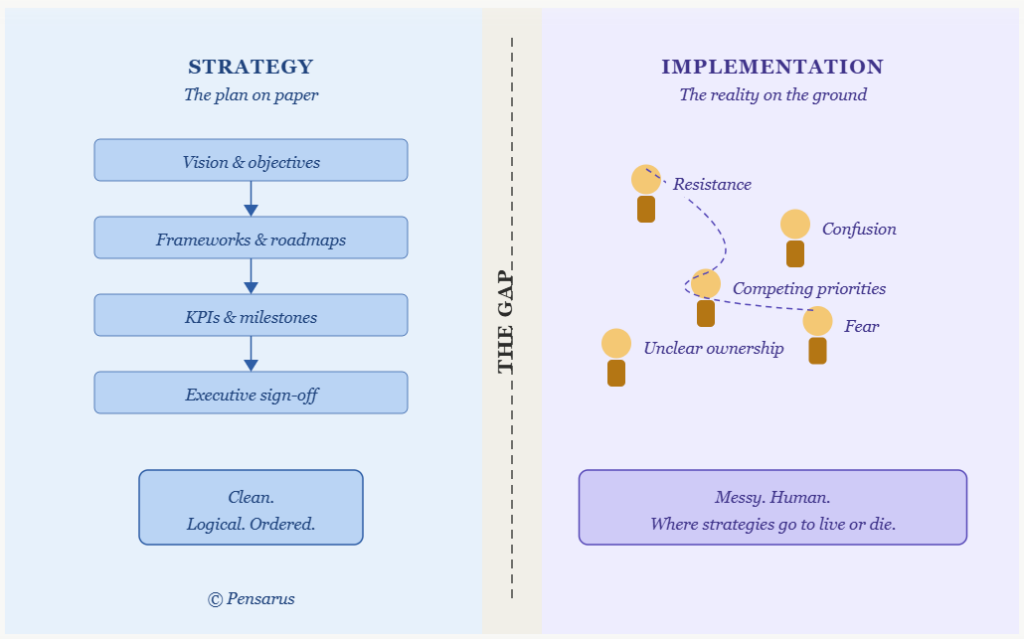
Every year, organizations pour billions into strategy. McKinsey, BCG, Deloitte, Accenture, Booz Allen — the marquee names are brought in to diagnose, design, and prescribe. The decks are polished. The frameworks are rigorous. The recommendations are sound.
And then the real work begins — the part that determines whether any of it actually lands.
Change management rarely gets the budget line it deserves. It’s not considered glamorous. It doesn’t carry the cachet of strategy consulting. But ask any seasoned executive who has watched a well-funded transformation stall at the implementation stage, and they’ll tell you: execution is where strategies go to live or die. Research consistently shows that a majority of large-scale transformations fail — not because the strategy was wrong, but because the human side wasn’t managed.
The Plug-and-Play Problem
When organizations do invest in change management, too often they treat it as a commodity. A contractor is brought in, a communication plan is drafted, a few training sessions are scheduled, and a checkbox gets marked. Engagement ends. The organization moves on — and the change doesn’t stick.
This approach mistakes activity for impact. Effective change management isn’t a deliverable. It’s a relationship. It requires understanding the culture, the informal power structures, the history of past initiatives, and the specific anxieties of the people being asked to work differently. That knowledge can’t be parachuted in and deployed in six weeks.
The irony is that organizations spend heavily on the strategy, then underinvest in the one function most responsible for realizing its value.
A Permanent Function Isn’t the Answer — But a Plan Is
Not every organization needs a standing change management office. That’s a legitimate business decision. But every organization that is serious about transformation needs a coherent approach to change — one that is intentional, resourced, and sustained long enough to take hold.
The question isn’t whether you can afford to invest in change management. It’s whether you can afford what happens when you don’t.
What Pensarus Does Differently
Pensarus has worked alongside some of the most respected names in strategy and IT consulting — McKinsey, BCG, Booz Allen Hamilton, Deloitte, Accenture — serving as the change management partner that turns strategic vision into organizational reality.
What distinguishes Pensarus isn’t methodology. It’s integration.
From the outset, the Pensarus team embeds itself within your organization — learning your culture, earning trust at every level, and operating as a genuine extension of your team. Clients don’t experience Pensarus as a vendor. They experience a partner who understands the stakes, knows the people, and is invested in the outcome.
And because Pensarus is structured as a third-party practice, you retain full flexibility. Scale engagements up during periods of intensive transformation. Scale back when the work plateaus. You get the continuity and institutional knowledge of an internal team without the fixed overhead.
That flexibility is grounded in three principles that define everything Pensarus does:
Agility — the ability to think creatively and navigate complexity across evolving environments, technologies, and organizational change.
Connection — deep partnership with client and stakeholder organizations, engaging leaders and teams with respect, empathy, and clarity to motivate action.
Expertise — deep experience across the disciplines that enable transformation, including management, education, behavioral science, and digital innovation, integrated to drive adoption and results.
Strategy sets the destination. Pensarus gets you there.