
We got the right people engaged and motivated. We got them to open up and be honest about the work to date.
That’s where stalled transformations actually begin to move again—not with new strategy decks or additional tooling, but with a clear, shared understanding of what is really happening on the ground.
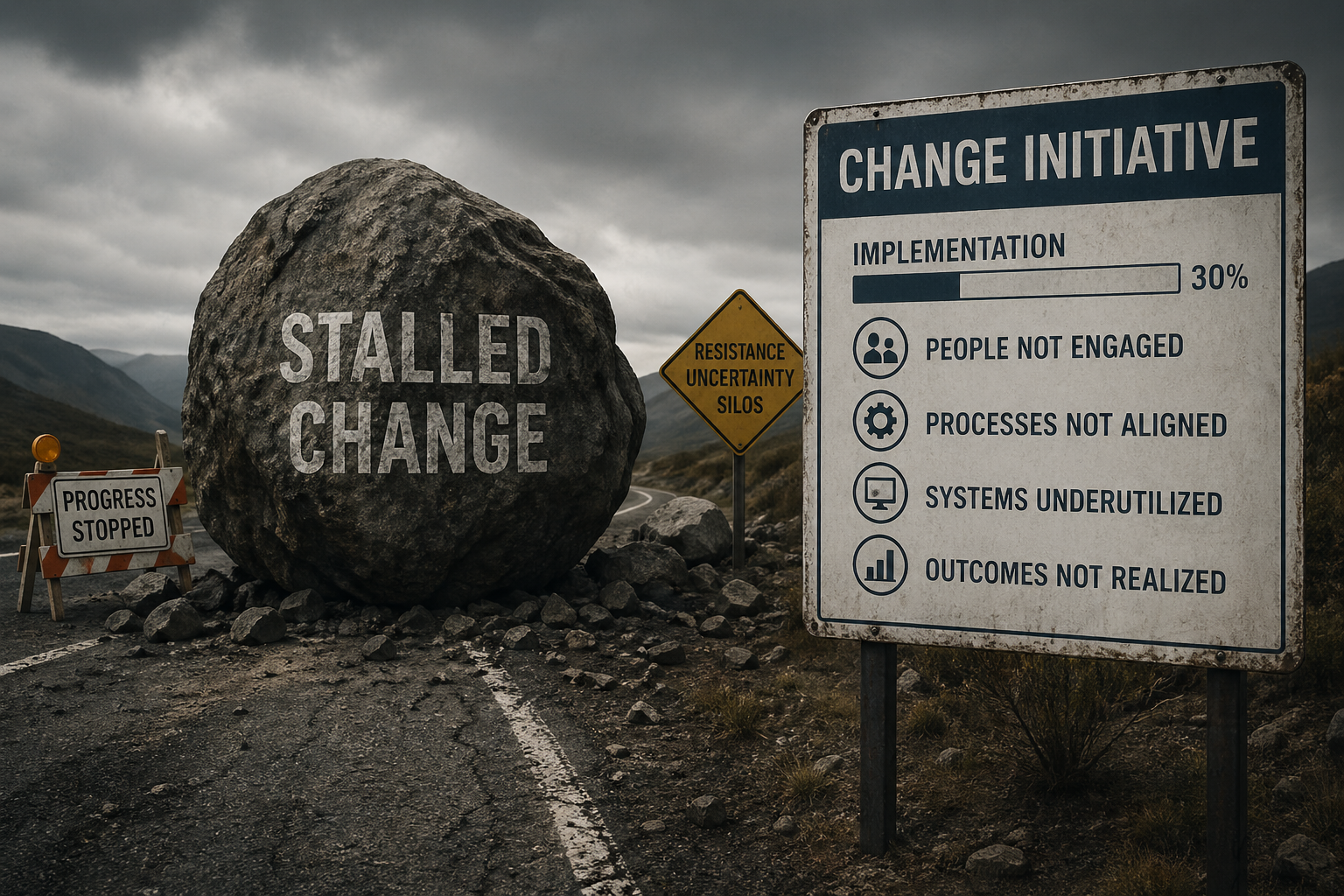
Across industries, organizations are investing heavily in transformation—particularly in AI, automation, and enterprise SaaS platforms. Yet outcomes remain inconsistent. Recent estimates suggest that more than 70% of digital transformation efforts fail to deliver on their intended results, and AI initiatives are increasingly following the same pattern: strong early investment, followed by stalled adoption and unrealized value.
In most cases, the issue is not the technology. It’s what happens during implementation.
Transformation doesn’t fail in strategy or deployment. It fails in adoption—in how work actually gets done.
At Pensarus, we approach transformation differently. We blend behavioral science, education, and management practices to influence how people adopt change, how work flows across teams, and where systems break down in real conditions. We step in when transformation has stalled and do the work required to move it forward.
In one case, a national nonprofit had implemented a new enterprise SaaS platform intended to modernize operations across its network. On paper, the transformation was complete. The platform had been deployed. Staff had been trained. The system was live.
In practice, almost no one was using it.
Data was incomplete and quickly becoming unusable. Legacy systems were still in use. Staff had reverted to familiar workflows that made sense in their day-to-day work but undermined the new system. Leadership had limited visibility into what was actually happening.
The organization had made a significant investment but had not made the transition.
When we assessed the situation, the problem was not resistance. It was misalignment. Processes had been designed for an ideal future state that didn’t reflect how work actually happened. Training had focused on system features rather than workflows. There was no clear plan for transitioning fully off legacy systems, and no shared understanding of when or how that would occur.
The system had been implemented, but it had not been integrated into the organization’s operating reality.
We did not redesign the transformation. We restarted it.
We worked directly with teams to reconfigure key workflows so the system supported how work needed to happen in the current environment. We made targeted adjustments to the platform to remove friction, rather than attempting a large-scale rebuild. We re-ran the transition—this time with structure—running systems in parallel, defining clear milestones, and establishing accountability for adoption.
We also addressed the behavioral side of the transition. We aligned leaders around consistent expectations, reinforced new ways of working in day-to-day operations, and created clarity about what “done” actually meant.
Finally, we supported a disciplined phase-out of the legacy system, ensuring that teams could move forward without duplication, confusion, or risk.
The result was not just improved usage. The organization completed the transition. The new platform became the system of record. Data integrity was restored. Redundant systems were eliminated. The organization avoided ongoing duplication costs and saved millions in operational inefficiency.
Most importantly, the system became part of how work actually got done.
Pensarus focuses on the phase of transformation most organizations underestimate—when implementation is complete, but adoption has not taken hold. We work with teams to realign workflows, re-establish momentum, and guide organizations through the transition from intent to execution, ensuring that transformation delivers measurable, sustained results.